
Event Planner vs. Event Producer: What's the Difference?
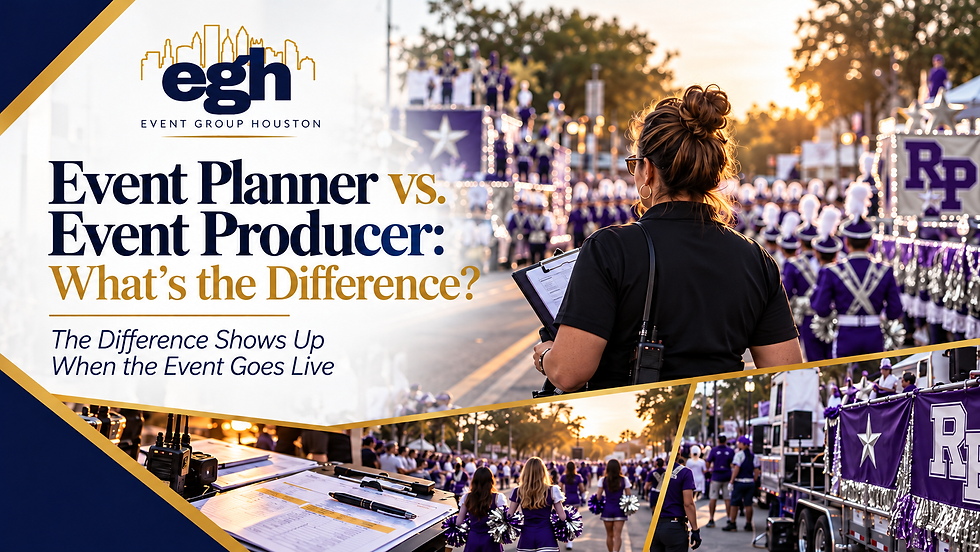
The Difference Shows Up When the Event Goes Live
A reflection on producing a high school Homecoming experience
Last night reminded me why I stopped describing myself simply as an event planner.
I've spent more than 20 years in the event industry. I've produced corporate events, celebrations, experiential programs and large-scale productions. I thought I understood what it meant to execute a complicated event.
Then I produced a high school Homecoming parade.
That experience reinforced something I've believed for years: the difference between an event planner vs event producer becomes most apparent when an event goes live. Planning is essential, but production is what brings the people, logistics, timing and experience together.
And somehow, this one took more out of me than almost any event I've ever produced.
Not because it had the largest budget. Not because it had the most elaborate decor or the biggest entertainment lineup.
It was the sheer number of people, personalities, expectations and moving pieces that had to somehow come together at exactly the right moment.
Thousands of attendees. Students. Parents. Coaches. Clubs. Administrators. Law enforcement. Emergency personnel. Vehicles. Trailers. Drivers. Buses. Sponsors. Volunteers. A parade route. Traffic control. Staging areas. Arrival waves. Emergency access. And an entire Homecoming celebration happening around it.
There were spreadsheets. Maps. Schedules. Staging plans. Traffic plans. Emails - so many emails. Phone calls. Changes. Corrections. More changes.
And because this was a school community, information didn't always travel in a straight line. It passed through coaches, parents, students, volunteers and committees before reaching the person who actually needed it.
At times, it felt like producing an event inside a giant game of telephone.
And somewhere in the middle of all of that, I learned a few things about event production. I also learned a few things about myself.
The Calm Before the "Structured Crazy"
Before the parade began, I gathered my co-captains and several volunteers for our pre-shift meeting.
I walked everyone through the operation one more time: staging, timing, movement, lineup, responsibilities, what to watch for and where people needed to go.
I had spent weeks looking at this operation, so in my head I could already see what was about to happen. But when I looked at my captains, I could see something else.
Stress.
They had the plans. They understood their assignments. But they were looking at everything that was about to converge on one relatively small staging area and wondering how in the world we were going to pull this off.
So I told them the truth.
"This is going to happen fast."
People aren't going to arrive perfectly according to the times we've given them. Some people aren't going to know exactly where they're supposed to go. Somebody will have heard something different from somebody else. People will have questions. And then, seemingly all at once, everybody is going to show up.
Stay calm.
It doesn't have to be perfect. We just need to get everyone as close to the planned order as possible, keep things moving and trust the structure we've built.
And then exactly what I told them would happen... happened.
At first, it was slow. Then suddenly, it was crazy.
Vehicles were arriving. Students were showing up. Groups needed direction. People had questions. Entries needed to move into position.
The operation came alive all at once.
But something remarkable happened inside all of that chaos.
The structure held.
One entry after another moved into place. The parade stepped off. And somehow, with all those people, vehicles, groups and moving parts, not one parade entry went out of order.
"It Was Structured Crazy."
After we sent the parade off, there was this little moment among us. We were almost in awe.
The thing that had existed on spreadsheets, maps and inside my head for weeks was suddenly moving down the street. And it was beautiful.
My captains came back to me afterward and essentially said, "You were right. It was slow, and then it got crazy."
And then came the description I don't think I'll ever forget:
"It was structured crazy."
I smiled because I thought: Exactly.
That's production.
Two of the volunteers working beside me have worked on my company productions before. They've seen what event day looks like behind the curtain. The others were fellow board members who don't professionally produce events.
And yet, standing inside the operation, they could see it. They could recognize the difference between random chaos and chaos being held together by a plan.
That meant more to me than they probably realized.
Because production isn't about eliminating chaos. In live events, that's almost impossible.
It's about building enough structure that when the inevitable chaos arrives, the event can absorb it without the audience ever feeling it.
And Then the Audience Took Over
Once the parade started, something changed.
The operational work disappeared.
The crowd didn't see our staging plans. They didn't know how many times the lineup had changed. They didn't know about transportation schedules, vehicle assignments, police positioning, emergency lanes or arrival waves.
They didn't see the problems we had solved before the first entry moved.
They saw students. They saw their children. They saw friends. They heard the band. They cheered. They laughed. They screamed.
And the energy was infectious.
For a moment, I watched something that had existed on spreadsheets, maps and inside my head for weeks become real.
Those weren't entries on my spreadsheet anymore. They were kids having the time of their lives.
Those weren't staging zones anymore. They were people celebrating.
The thing that had consumed my thoughts for weeks had become joy for somebody else.
And for a producer, there isn't much better than that.
That's Production
Great production is often invisible.
When we've done our jobs well, the audience doesn't experience our logistics.
They experience the moment those logistics made possible.
That's also why having all the pieces of an event doesn't necessarily mean you have created an experience.
You can have tents. Tables. Food trucks. Activities. Entertainment. Vendors. Signage.
Every box on the checklist can seemingly be checked.
But someone still has to think about what happens when people actually arrive.
Where will they enter? Where will they naturally walk? What makes them continue through the space? Can they see what's happening in other areas? Are there places people will unintentionally bypass? Is everything properly lit? Where will crowds naturally gather? Where will traffic bottleneck? What happens when a vendor doesn't show? What happens when hundreds of people arrive at once? How does the energy move through the experience?
Those are the questions that fascinate me.
Because that's where an event stops being a collection of things and starts becoming an experience.
Event Planning and Event Producing Aren't Enemies
This isn't about one profession being better than another.
There are phenomenal event planners, and many professionals perform both roles. But planning and producing aren't always the same function.
Planning puts the pieces in place.
Production engineers how those pieces work together once people arrive.
A beautiful floor plan doesn't guarantee that guests will move through it. Assigning a vendor a space doesn't guarantee people will engage with them. Putting an activity somewhere doesn't mean guests will find it. And a schedule isn't an experience.
A producer has to think about the event as a living environment: people, movement,
energy, timing, operations and emotion - all happening simultaneously.
I Didn't Get Everything Right
This part matters to me, because I don't want to tell this story as though everything I touched worked perfectly.
It didn't.
I made mistakes too.
One in particular bothers me because I know better.
I missed my final driver check.
During the final days of production, responsibilities were shifting. Different people were coordinating different pieces. Plans were changing quickly. Information became fragmented.
And I allowed myself to become distracted by some of the conflict happening behind the scenes.
That's mine.
I can't control every personality involved in a production. I can't control every decision someone else makes. But I can control whether I protect my own process.
And in that particular area, I didn't protect it well enough.
I should have maintained one centralized driver list. One confirmation process. One vehicle assignment system. One final operational check.
Instead, information was moving through multiple people and conversations, and I lost complete visibility into one piece of my own operation.
We solved it. The parade moved. The audience probably never knew.
But I knew.
And that's enough for me to examine it - not to beat myself up over it, but to learn from it.
Sometimes Leadership Means Looking at Yourself
That mistake taught me something bigger than driver assignments.
I allowed conflict behind the scenes to consume too much of my attention. And that's difficult for me to admit.
When you've spent weeks building something and care deeply about its success, it's easy to become protective of the plan. It's easy to get pulled into disagreements. It's easy to spend energy explaining decisions, responding to changes and trying to maintain control of something that feels like it's moving in multiple directions.
Eventually, you can find yourself reacting more than producing.
I did some of that. And I don't want to carry that lesson forward without acknowledging it.
Because leadership doesn't mean saying, "Everything that went wrong was somebody else's fault."
It also doesn't mean taking responsibility for things that weren't yours.
It means being able to look at the entire experience and say:
Here's what worked. Here's what didn't. Here's what belonged to me. And here's what I'm going to do differently next time.
For me, the answer isn't fighting harder over every decision.
It's stronger operational structure. Clear ownership. Defined decision-making authority.
One source of information. Documented changes. Accountability. And boundaries around the production process.
Because when the producer loses visibility, the operation becomes vulnerable.
Filling a Space Isn't the Same as Producing One
The entire Homecoming experience also reinforced something I've believed for years about experiential events.
People don't automatically explore an event simply because we put something there.
Movement has to be designed.
Traffic has to be considered. Energy has to be directed. People need visual cues. They need reasons to move. They need intentional transitions between experiences.
Lighting matters. Placement matters. Visibility matters.
The location of a tent, table, activation or vendor can determine whether it becomes part of the guest experience - or simply exists somewhere on the property.
Sometimes you can have all the right ingredients and still discover that they aren't interacting with each other the way you expected.
That's not something to hide from. That's something to study.
What happened? Where did people naturally go? Where didn't they go? What changed when the crowd arrived? What would we design differently next time?
That's how producers get better.
This One Took Something Out of Me
I've been doing this for more than 20 years.
And I don't remember many events leaving me quite like this one did.
When it was over, I wasn't simply tired.
I was mentally and emotionally overstimulated.
There had been too many decisions. Too many conversations. Too many moving pieces.
Too many moments where something depended on something else.
And, if I'm being completely transparent, too much emotional energy spent on things that weren't actually production.
That is something else I'm taking with me.
Protecting the production also means protecting the producer.
Because you cannot make your best decisions when your mental bandwidth is being consumed by things that shouldn't have access to it.
That's a boundary I'm still learning - even after 20 years.
But Then I Remember the Parade
I keep coming back to that staging area.
My captains looking overwhelmed.
Me telling them: Stay calm. Trust the structure. It's about to happen really fast.
And then watching it happen.
Slow.
Crazy.
Structured crazy.
And finally...
Beautiful.
I walked away proud of what we created, aware of what I could have done better, and reminded that leadership doesn't require perfection.
It requires the willingness to own your part, learn from it and keep growing.
There will always be another event. There will always be something I can improve. There will always be personalities I can't control, circumstances I couldn't anticipate and lessons that don't reveal themselves until the event goes live.
But this experience reminded me why, after more than two decades, I still love producing.
Not because I love spreadsheets. Not because I love maps. And definitely not because I love hundreds of emails.
I love the moment when all of those invisible things disappear.
When the plan becomes movement. When the logistics become energy. When the work becomes an experience.
And when the people you've been building it for have absolutely no idea how much went into making that moment possible.
They just know they're having an incredible time.
Planning puts the pieces in place.
Production makes them work together.
And sometimes, if you've done your job well, what looks like complete chaos from the outside is actually something much more beautiful.
It's structured crazy.
Amanda Mora Founder & Executive Producer, Event Group Houston
Comments